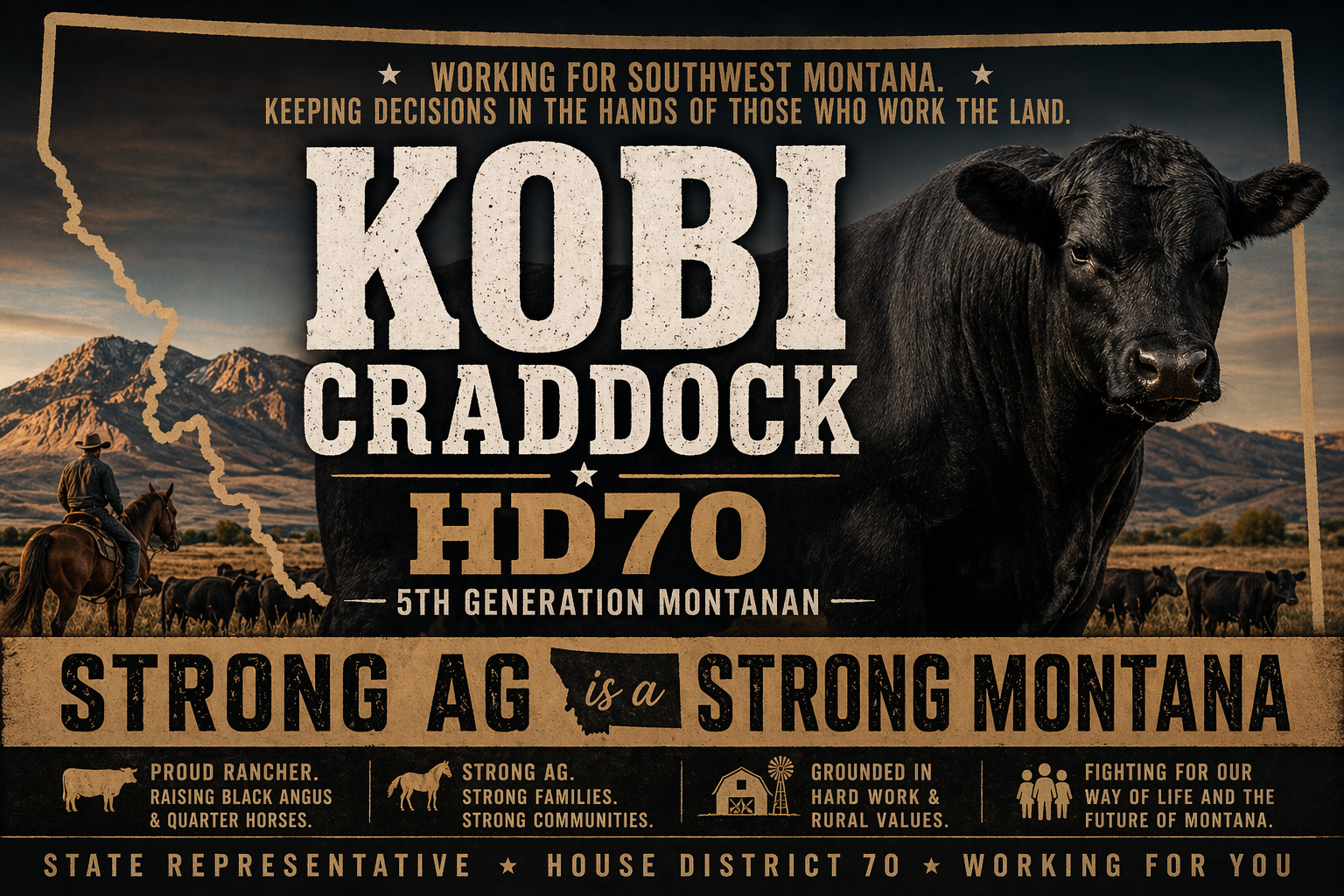
Agriculture is more than an industry in Montana. It is part of our economy, our communities, our history, and our way of life.
I believe agriculture policy should start with one simple question: are we helping the people who actually produce the food stay on the land and make a living doing it?
As a cattle producer myself, I understand that ranching is not just about market prices or what happens at the sale barn. It is about feed costs, drought, water, fencing, fuel, equipment, veterinary care, land access, processing capacity, and the constant uncertainty that comes with weather and markets. Those pressures are real, and too often policy is written without enough input from the people who deal with them every day.
I want Montana to build an agricultural economy that rewards producers, strengthens local communities, and keeps more of the value of Montana-grown food here at home.
Shortening the Chain Between Producer and Consumer
We need to cut out as many unnecessary steps as possible between the ranch gate and the dinner plate.
Montana raises some of the best beef and agricultural products in the country, but too often those products leave the state, move through multiple layers of processing and distribution, and then return to Montana consumers at a much higher price.
I support expanding direct producer-to-consumer opportunities, strengthening local and regional processing capacity, and removing unnecessary barriers that make it harder for producers to sell directly to the people who want to buy from them.
Consumers deserve more opportunities to know where their food came from, how it was raised, and who produced it. Producers deserve a fairer share of the final value of the food they raise.
A stronger local food system benefits both.
Keeping Montana Food in Montana
I believe Montana should make a greater effort to purchase Montana-raised and Montana-grown food for schools, universities, correctional facilities, state institutions, and other publicly funded programs whenever it is practical and financially responsible.
When Montana tax dollars are already being spent on food, we should ask whether more of those dollars can stay here and support Montana producers.
That creates dependable markets for producers, strengthens local processing, supports rural communities, and keeps more money circulating inside our state economy.
I also support creating better incentives for producers who donate food to local food banks and community organizations. Montana produces an incredible amount of food, and there should be practical ways to connect that abundance with Montanans who need it.
Competition and Fair Markets
A healthy agricultural economy requires real competition.
Producers should not be expected to carry all the risk while having little control over the price they receive for what they raise. When too much market power becomes concentrated in too few hands, ranchers and consumers can both lose.
I support greater transparency in livestock markets and stronger enforcement of laws designed to prevent anti-competitive practices.
I also believe consumers should have clear information about where their food originates. Country-of-origin transparency gives consumers the ability to support American and Montana producers if they choose to do so.
A free market only works properly when producers have genuine opportunities to compete and consumers have honest information.
Protecting the Family Farm and Ranch
Montana should remain a place where family farms and ranches can survive.
Rising land values, taxes, operating costs, development pressure, drought, and consolidation all make it increasingly difficult for smaller and mid-sized producers to stay in agriculture.
I do not believe the answer is to bury agriculture under more bureaucracy. I believe the state should focus on removing unnecessary barriers, protecting agricultural land, improving market opportunities, and making sure programs intended to help producers actually reach the people working the land.
We also need to think about the next generation. If young Montanans cannot afford to enter agriculture, eventually we lose not only farms and ranches, but the knowledge, communities, and stewardship that go with them.
Water, Drought, and Disaster
Water is one of Montana agriculture’s most important resources, and responsible water policy is critical to the future of our state.
I believe agricultural producers, municipalities, conservation districts, tribes, recreation interests, and other water users must be part of the conversation when major water decisions are made.
Montana also needs to be better prepared for drought, wildfire, severe winters, and other disasters that can devastate producers in a single season.
I support practical disaster-response mechanisms that can provide timely assistance without creating unnecessary bureaucracy. The goal should be helping viable operations survive extraordinary events rather than forcing producers to navigate complicated programs months after the damage has already occurred.
Agriculture and Conservation
I reject the idea that agriculture and conservation have to be enemies.
Farmers and ranchers manage millions of acres of Montana land. Healthy soil, clean water, productive grasslands, wildlife habitat, and long-term agricultural viability are often connected.
Good conservation policy should recognize producers as partners.
I support voluntary conservation programs, responsible grazing, watershed improvement, proactive forest management, and cooperative approaches that protect natural resources while respecting private property and agricultural production.
The best solutions are usually developed with the people who actually live and work on the land at the table.
Private Property and Local Control
Private property rights are fundamental.
Agricultural producers should have confidence that government will respect their land, water, and livelihoods. At the same time, Montana has longstanding traditions involving public lands, hunting, fishing, recreation, and shared natural resources.
I believe we can protect private property while also finding practical solutions to access and land-management issues.
Whenever possible, decisions affecting Montana agriculture should be made close to the people they affect. State and local leaders often understand Montana conditions better than distant federal agencies operating under one-size-fits-all rules.
A Montana-First Agricultural Economy
My goal is not simply to preserve agriculture as something from Montana’s past.
I want agriculture to remain a strong part of Montana’s future.
That means creating more opportunities to process Montana products here, sell them here, serve them here, and build businesses around them here.
It means making sure the people raising the food have a meaningful voice in the policies affecting them.
And it means recognizing that when Montana agriculture succeeds, the benefits reach far beyond the farm or ranch gate. They reach equipment dealers, truckers, processors, grocery stores, restaurants, schools, small towns, and families across the state.
My approach to agriculture can be summed up simply:
Protect the producer. Strengthen the market. Shorten the distance between the ranch gate and the dinner plate. Keep more Montana food and Montana dollars in Montana.

